The Silk Road Conference on Cash & Payments: The Future of Money
The Silk Road Cash & Payments Conference is an initiative that brings global knowledge and experience to Central Asia and surrounding regions and markets.
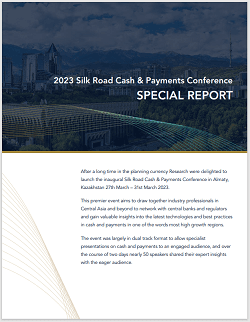
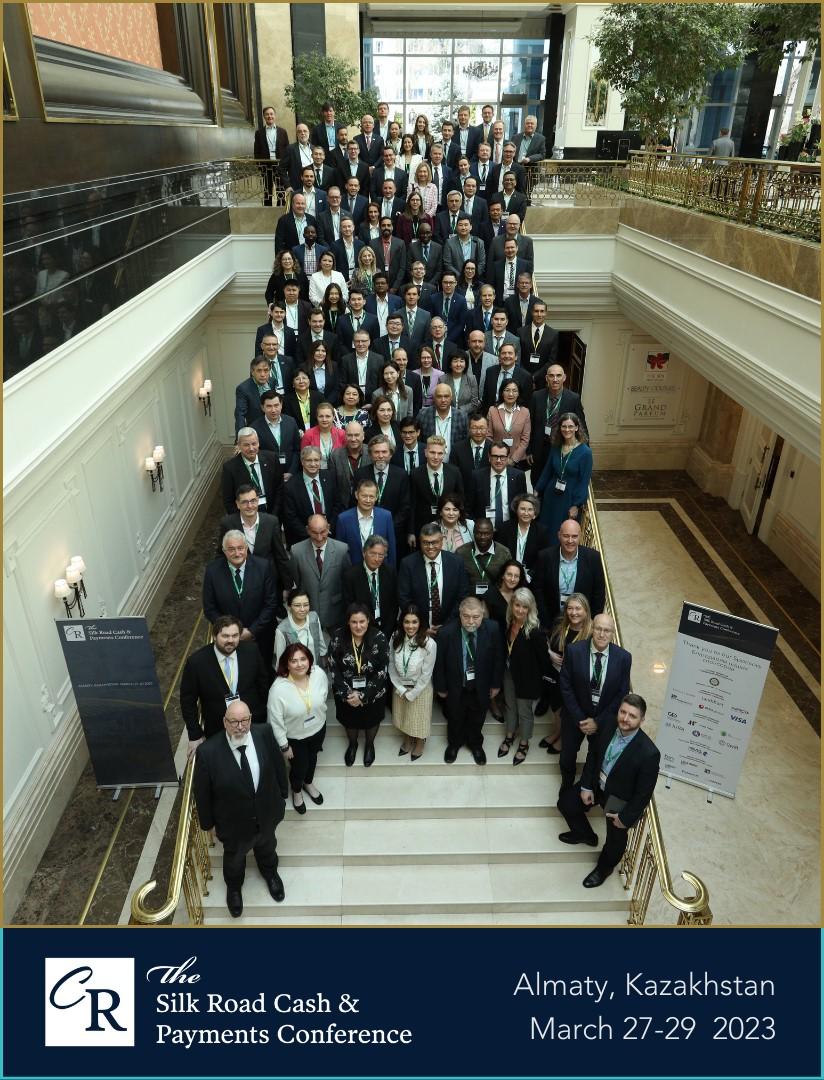
The inaugural Silk Road Cash & Payments Conference took place from 27-29 March 2023 in Almaty, Kazakhstan. The conference welcomed 135+ delegates, from 66 organizations, 19 Central Banks, and 32 countries.
Click HERE to download the Special Report covering the full conference!
We invite you to fill out our form to receive updates and insider information about the next Silk Road Cash & Payments Conference.
Thank you for your interest.
Who Did Attend?
Central Banks/Issuing Authorities, Governments, Regulators
State Printing Works, Commercial Printing Works
Law Enforcement Agencies, Counterfeit Analysts, Banknote Quality Control Specialists, Fraud & Risk Management Experts, Pre-press, printing, finishing and inspection equipment and Banknote Processing Equipment Manufacturers
Suppliers of substrates and security features, Suppliers of specialist services for the security printing market
ATM Equipment/Service Providers, Independent ATM Deployers, Cash Recycler Manufacturers
Armoured Carriers, Cash-in-Transit (CIT) Companies, Outsourced Cash Processors, Foreign Exchange Companies, Cash Forecasting Software/Service Provider, Automation Specialists
Payments Agencies/Associations, Regulatory Compliance Specialists
Secured Packaging Specialists, Theft Prevention Specialists
What Delegates Are Saying About Our Events
"Impressive, brilliant, and worthwhile"
– Monetary Authority of Brunei Darussalam
"The Conference was VERY WELL organised and flowed very well. There was good representation from numerous stakeholders in the Industry."
– South African Reserve Bank
"It was a great experience with a global community who are in the same field but with different dimensions. Had a good time with all of them gathering and exchanging knowledge and experience. I would like to thank Currency Research for organizing this seminar enabling all stakeholders to get together and exchange their views and innovative ideas."
- Central Bank of Sri Lanka
"This [event] creates a community in payment systems which encourages sharing and networking among the countries."
- Central Bank of Indonesia
LIMITED TIME ONLY
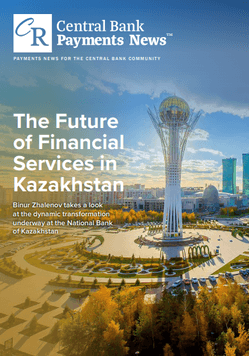
Complimentary access to the Central Bank Payments News Feature Article by The National Bank of Kazakhstan
LIMITED TIME ONLY
The full feature article by The National Bank of Kazakhstan in the September 2022 issue of the Central Bank Payments News is being made available in a downloadable verion.
Click HERE to access it immediately!

- Banknote Design, Specification & Production
- Cash & Payments Trends
- Central Bank Digital Currencies (CBDCs)
- Coin Production & Circulation
- Cross-border Payments – How Frictionless Can They Be?
- Efficiency, Optimization & Automation in Processing & Circulation
- Modernization of Payments Infrastructure: Lessons Learned
- Sustainability in Cash Production and Distribution
- Universal Access to Payments
The New Silk Road and Why It Matters
The ancient Silk Road famously connected the Roman Empire and China and enabled trade between the two continents, with the name-giving silk, amongst other goods, moving westwards, and gold, silver and other items going east. To what extent trade was based on bartering, and to what extent the silver, gold and perhaps other valuable items were considered payments is perhaps of historical interest; it is clear though that today, payments will have to be a key enabler for the success of a New Silk Road.
The New Silk Road initiative originated with S. Frederick Starr, chairman of the Central Asia-Caucasus Institute at Johns Hopkins University, and was announced in October 2011 in Chennai by Hillary Clinton, then US Secretary of State. It was predominantly positioned as a measure to provide long-term stability to Afghanistan, but also to strengthen the independence of Central Asian countries overall. From its launch there were critical voices, too, and speculation not only with regards to the economic goals of this undertaking, but also with regards to the geopolitical motives behind the initiative. With the exception of a handful of infrastructure projects, not much came of the initiative, and President Trump’s attempt to revive the New Silk Road initiative with a couple of projects in cooperation with India also did not go very far.
In 2013, President Xi Jinping announced China’s very own plans to establish a double trade corridor connecting China with Central and South Asia, the Middle East, parts of Africa and Europe. The Belt and Road Action Plan, a multi-trillion Dollar investment scheme, was released in 2015, and dubbed One Belt, One Road (or OBOR) in English. The naming is somewhat confusing as “the road” actually describes the maritime Silk Road, so relies heavily on transport by ships, while “the belt” refers to a road network through Central Asia, Scandinavia and Central Europe. Not unlike the former US initiative, OBOR also has its critics, who are not only questioning the true motives of the Chinese government, but also as in the case of India’s Prime Minister Modi, outright rejecting the initiative.
Whatever the political motives might be, there is no question that the New Silk Road, or One Belt, One Road, will bring significant infrastructure changes to a vast geographical region. It will bring construction of roads and ports and ultimately enable more cost effective and timely trade between many countries connected to the new infrastructure. For trade to be effective and timely though, and for the businesses and people in those countries to benefit from the economic upswing, the payments infrastructure has to be fit for purpose, too. Fast, affordable and reliable cross-border payments are of course the most obvious area to consider, but these will only provide the full benefit if domestic payment systems are also ready to seamlessly interface with the international rails. Compliance solutions need to align with the new requirements, and even cash very much needs to be considered, be it for the facilitation of smaller cross-border transactions or of course increased domestic use in a region where cash still reigns supreme.
Digital payments players such as PayPal or Alipay may potentially provide solutions, but may also pose new challenges if they are not properly regulated. If designed and implemented in the right way, central bank digital currency could be a more suitable enabler for safe, cost-effective, and frictionless payments. And what are the plans for the eCNY and is it already woven into the very fabric of the New Silk Road? Could a Digital Euro or an eDollar compete with that approach, and what are the critical factors to make sure they can? The payment industry surely has its work cut out.
With all these possibilities and challenges, co-ordination and the exchange of information between Central Banks, regulators and payment professionals will be key to making sure that the payment infrastructure will improve in line with new volumes and requirements. The conference will lay the foundation to closer cooperation and exchange of information between the relevant organisations in the region and provide a platform for discussion, learning and ideation.
THANK YOU TO OUR SPONSORS
CO-HOST EXHIBITOR

PRIMARY SPONSORS





SUPPORTING SPONSORS





POPUP EXHIBITORS

MEDIA PARTNERS